


Short answer
Padel is built on a handful of shots. From the back of the court you play drives, lobs and shots off the walls. At the net you play volleys and overheads: the bandeja, the víbora and the smash. The serve and the return start every point, and the chiquita helps you win the net. Every shot is played forehand or backhand, and flat or with slice. Knowing which one to choose, and when, matters more than hitting any of them hard.
All padel shots at a glance
This table sums up every shot. Each one has its own guide with technique, mistakes and drills.
| Shot | Where on court | When you play it | Spin |
|---|---|---|---|
| Drive and backhand | Back of the court | To keep the rally going and build the point | Mostly slice, sometimes flat |
| Lob | Back of the court | To push your opponents away from the net and win it back | Flat or slice |
| Shots off the walls | Back of the court | When the ball comes off the back or side glass | Depends on the shot |
| Chiquita | Back or middle | A soft, low ball to your opponents’ feet, to move forward | Slice |
| Volley | At the net | Before the bounce, to place the ball and keep pressure | Mostly slice or block |
| Bandeja | Net to mid-court | Answering a lob while keeping the net | Slice |
| Víbora | Net to mid-court | Answering a lob with more pace and side spin | Slice and side spin |
| Smash | Net to mid-court | Finishing the point on a short lob | Flat or topspin |
| Serve and return | Behind the service line | Starting every point | Slice or flat |
Start here with Prodigy Padel Academy


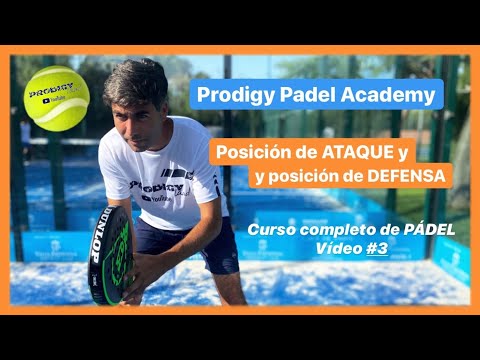
Defence and attack: why the net matters
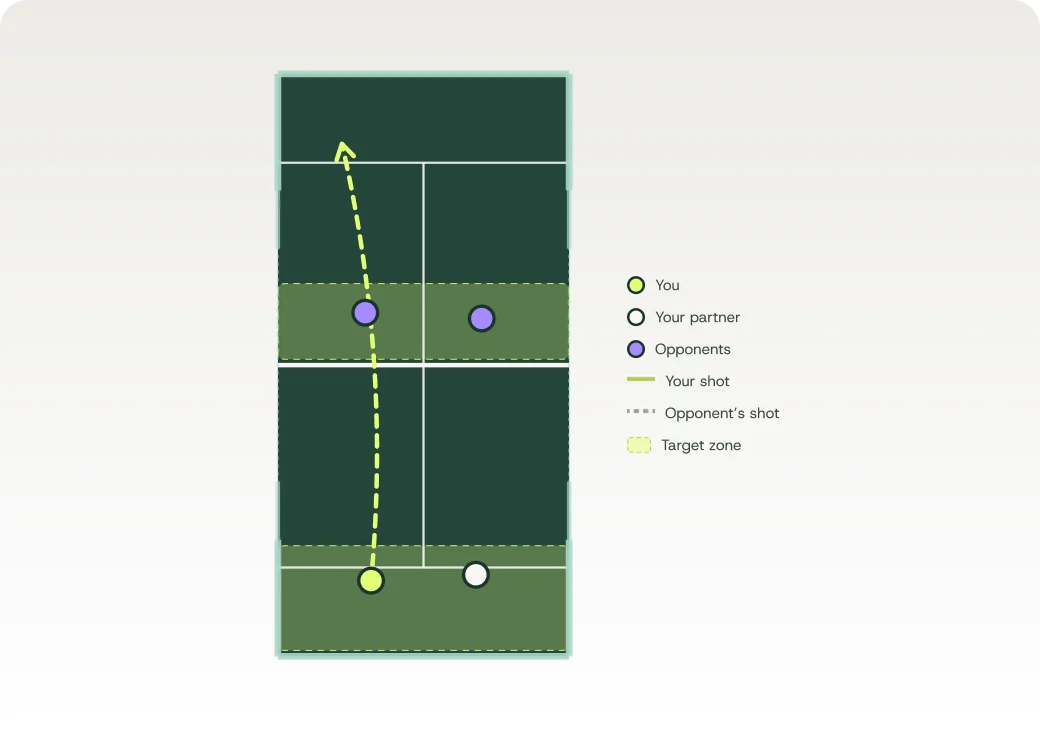
In padel the team at the net usually controls the point. The team at the back defends, waits for a chance and tries to win the net back with a lob or a chiquita. The team at the net attacks with volleys and overheads, and tries to keep the net when it is lobbed. Almost every shot choice comes back to this one question: do I attack, defend or win the net back?
Forehand or backhand, flat or slice
Every shot also has a side and a spin. The side is forehand or backhand. The spin is how you hit through the ball: flat travels faster and bounces higher, slice brushes under the ball, stays low and gives you more control. Most padel players slice far more than tennis players do, because a low ball off the glass is hard to attack.
Many players run around their backhand without realising it, and some slice almost everything because it feels safe. Neither is wrong, but you can only change it once you see it.
The shots from the back of the court
Drive and backhand
Your groundstrokes after the bounce. Compact, with control over power, aimed low at the feet of the net players or through the middle.
Lob
High and deep over your opponents at the net. The main way to win the net back.
The walls
Letting the ball come off the back or side glass and playing it after. The skill that makes padel different from tennis.
The shots at the net
Volley
Short and compact, before the bounce. You place the ball instead of swinging at it.
Bandeja and víbora
Controlled overheads that answer a lob and keep you at the net. The víbora is the faster, more aggressive one.
Smash
The full overhead to finish the point, flat or with topspin so the ball bounces out of the court.
Starting and changing the point
Serve and return
An underhand serve, hit at or below the waist, starts every point. The return decides whether you can attack or have to defend.
Chiquita
A soft, low ball to the feet of the net players. It forces them to volley up and gives you time to move forward.
How Padelplay recognises your shots
- The sensor records the movementA motion sensor (accelerometer and gyroscope) at the bottom of your handle records how the racket moves, turns and slows down through every swing.
- Every hit is foundAfter the session, the algorithm finds each moment of impact, and a neural network removes movements that only look like a hit.
- Each shot is classifiedEvery hit gets a type (drive, volley, lob, bandeja or smash), a side (forehand or backhand, using the playing hand in your profile) and a spin (flat or slice). The smash also gets a Smash Factor.
Padelplay recognises shots with 85% accuracy or higher, depending on the shot. Shots with a similar movement, such as a volley, a bandeja and a flat forehand, are the hardest to tell apart. Read more on how the sensor works.
Which shots Padelplay recognises today
Not every shot in this guide has its own category in the app yet. This is what the sensor recognises today:
| Shot | In your matches | In training mode (beta) |
|---|---|---|
| Drive and backhand | Yes, forehand or backhand, flat or slice | Yes |
| Lob | Yes, forehand or backhand, flat or slice | Yes |
| Volley | Yes, forehand or backhand, flat or slice | Yes |
| Bandeja | Yes, forehand or backhand, flat or slice | Yes |
| Smash | Yes, with the Smash Factor | Yes |
| Víbora | Not yet as a shot of its own | Not yet |
| Chiquita | Not yet as a shot of its own | Not yet |
| Serve and return | Not yet as shots of their own | Not yet |
| Shots off the walls | Not yet: the sensor does not see the wall | Not yet |
“Not yet” means the app does not show the shot as a category of its own. You can still play it with the sensor on and tag a mistake with one tap. We will update this table as new shot types are added.
What you can do with it
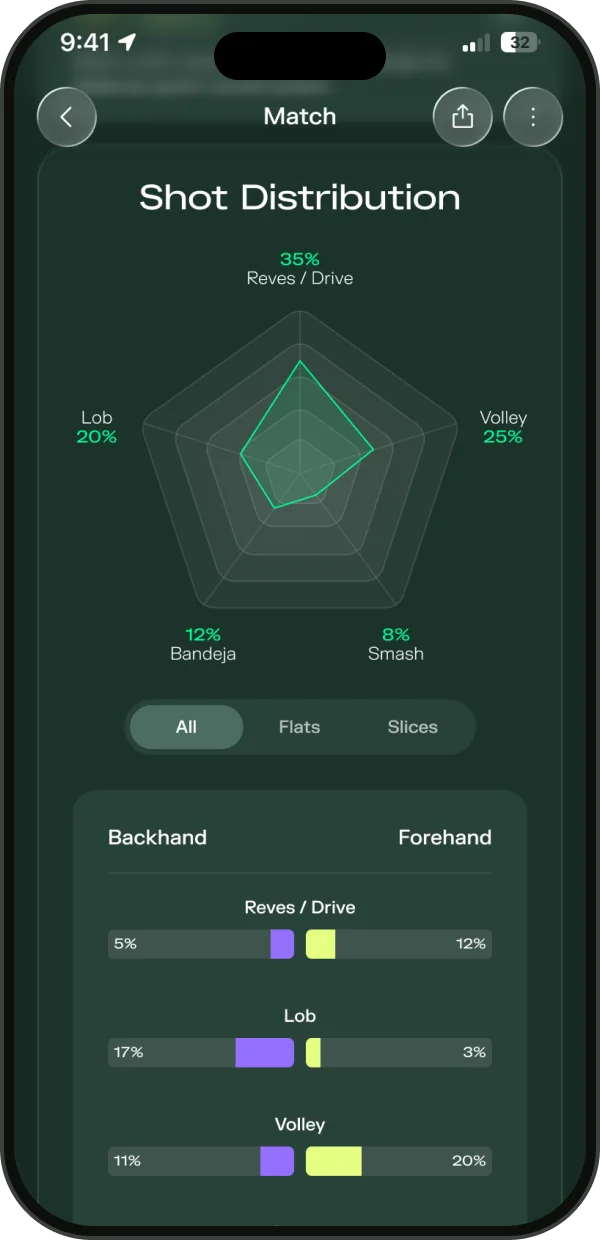
- See your real shot mix. How much of each shot you play, per match and over time.
- Find your weak side. The forehand and backhand split shows whether you avoid one side.
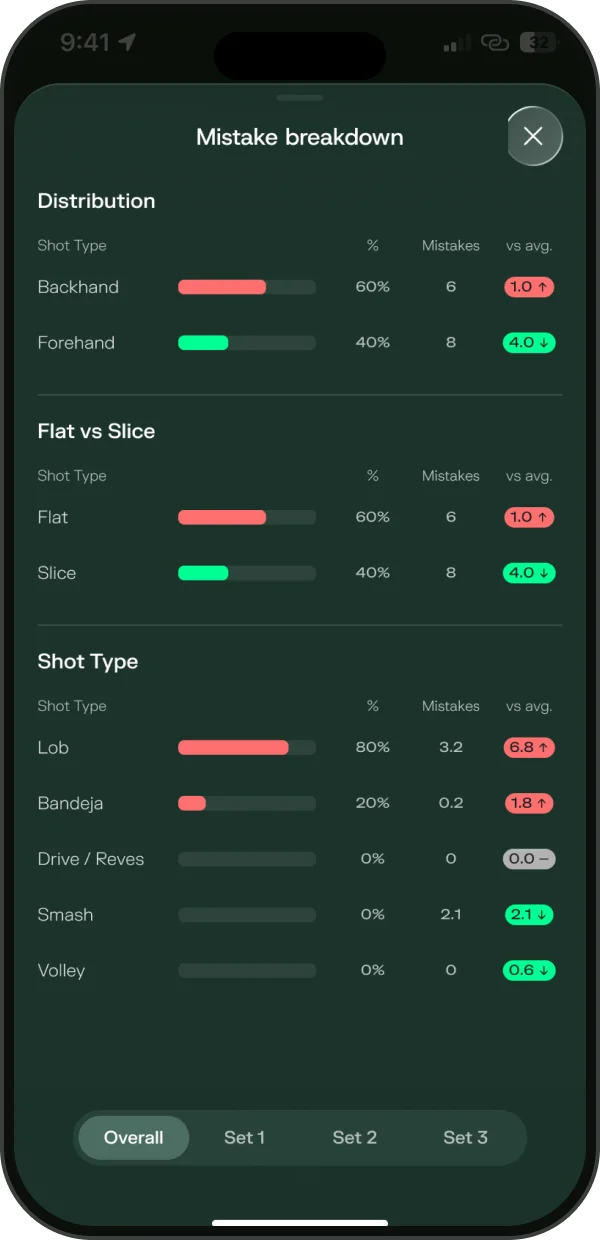
- Check your spin. Flat or slice per shot tells you whether you control the ball or just hit it.
- Link shots to mistakes. Tag a mistake with one tap and see which shot, side and spin it was. Read the 10 most common mistakes.
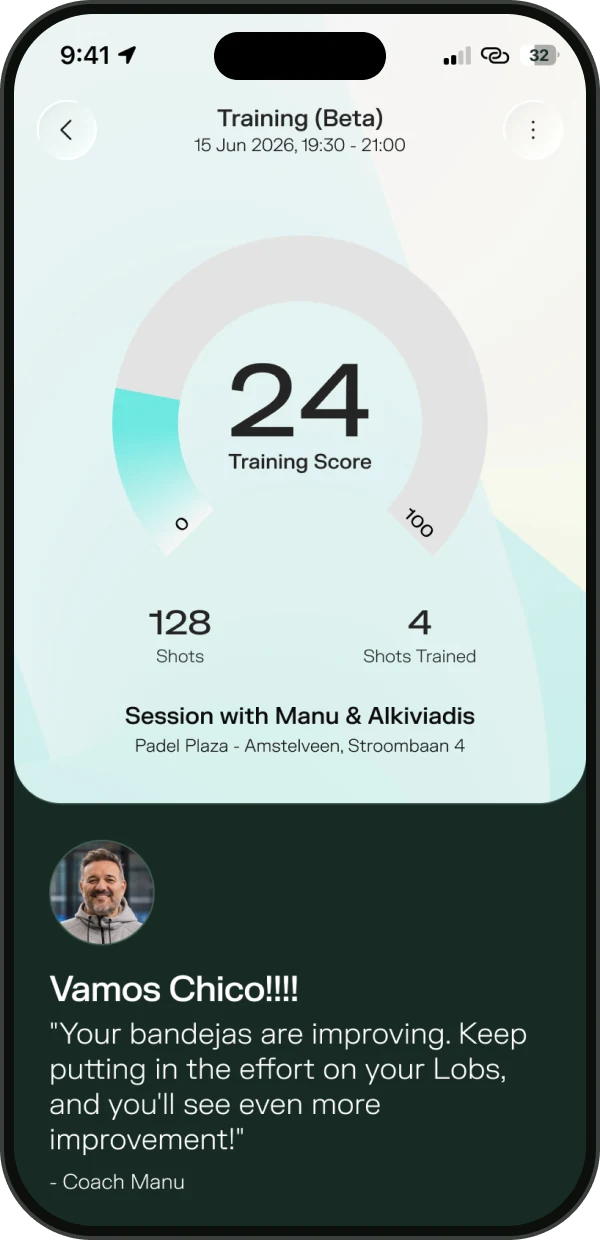
- Get advice. After a match with a score and at least 50 shots, Coach Manu points out what to work on next.
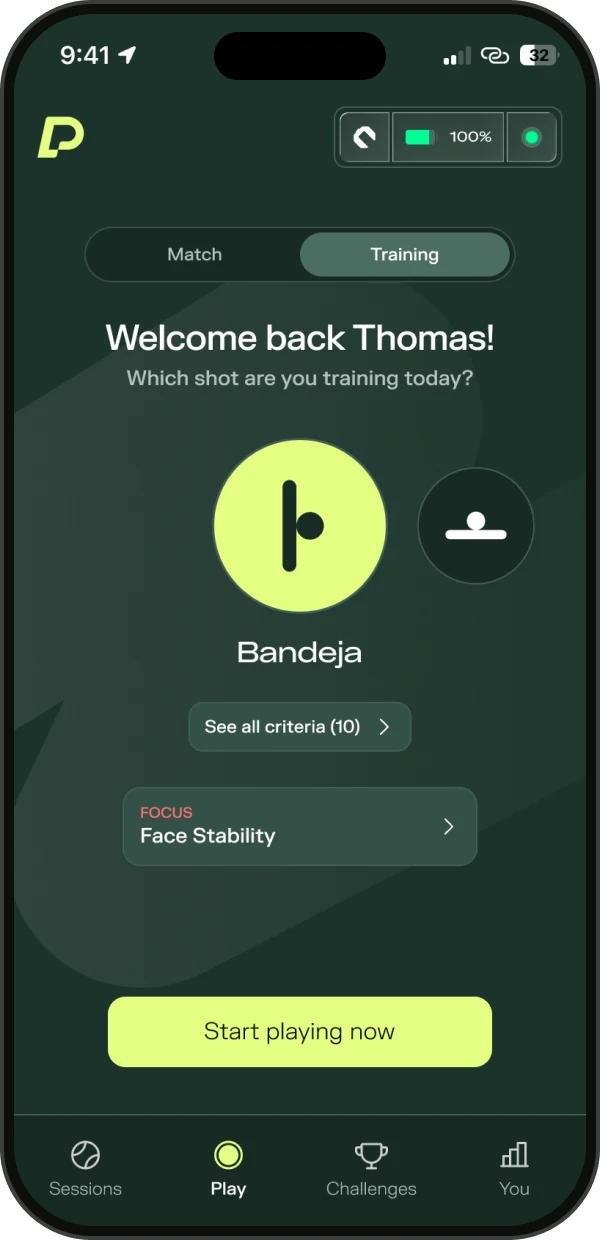
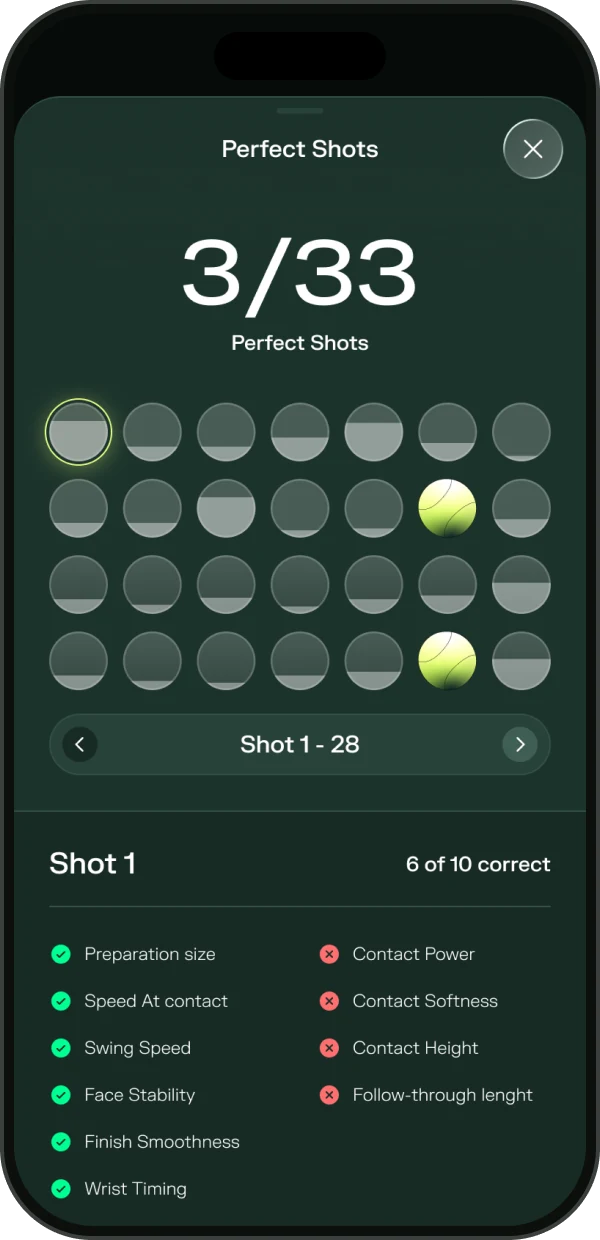
- Train one shot at a time. In training mode (beta) you pick the smash, bandeja, drive, volley or lob, and every attempt is scored against reference swings from professional players.
Frequently asked questions
How many shots are there in padel?
There is no official number. Most coaches teach around ten: drive, backhand, lob, volley, bandeja, víbora, smash, shots off the walls, chiquita, and serve and return.
Which padel shot should I learn first?
The drive, the backhand and the volley, together with letting the ball come off the back wall. Overheads come next.
What is the difference between a bandeja, a víbora and a smash?
The bandeja keeps the net with control, the víbora adds pace and side spin, the smash tries to win the point.
Why do padel players slice so much?
A sliced ball stays low after it bounces and comes off the glass slowly, which makes it hard to attack.
Want to see which shots you actually play? See how Padelplay tracks every shot.

