


Short answer
For improving your technique, a sensor mounted on the racket is the better choice, because it measures the racket itself rather than your wrist. Before you buy, check four things: which shots it recognises, battery life, whether it fits your racket, and what the app shows you over time.
The padel sensor market is small enough that most players don't know it exists, and new enough that today's options look very different from two years ago. This guide explains the two types of sensor, which metrics actually matter, and what to check before you spend your money.
What a padel sensor does
A padel sensor is a small device that tracks your shots while you play. It uses an accelerometer and a gyroscope, the same motion sensors found in phones and fitness wearables, to measure how the racket or your wrist moves during each swing.
That motion data goes into an AI model that recognises each shot: forehand, backhand, volley, smash, bandeja, lob or slice. After the session the data appears in an app, where you see which shots you played, how your smash compares, how many mistakes you made and how all of that changes over time.
The two types of padel sensor
There are two fundamentally different designs. The type you choose matters more than the brand.
Wrist-worn sensors
A thin band on your racket arm. Works with any racket, but the wrist is one step removed from where the shot happens. A forehand drive, a backhand slice and a smash can look alike from the wrist, so shot recognition is harder and quality scores less precise.
Racket-mounted sensors
Sits at the bottom of the handle and measures how the racket itself moves, rotates and slows down through every shot. Being that close to the point of impact gives far more signal. The Padelplay sensor weighs 15.6 grams including its silicone mount, and most players stop noticing it after a session or two.
If your goal is to understand and improve your technique, choose a racket-mounted sensor. You want the measurement as close to the ball as possible.
Which metrics actually matter
Not every sensor tracks the same things, and not every number helps you improve. These are the ones worth paying attention to.
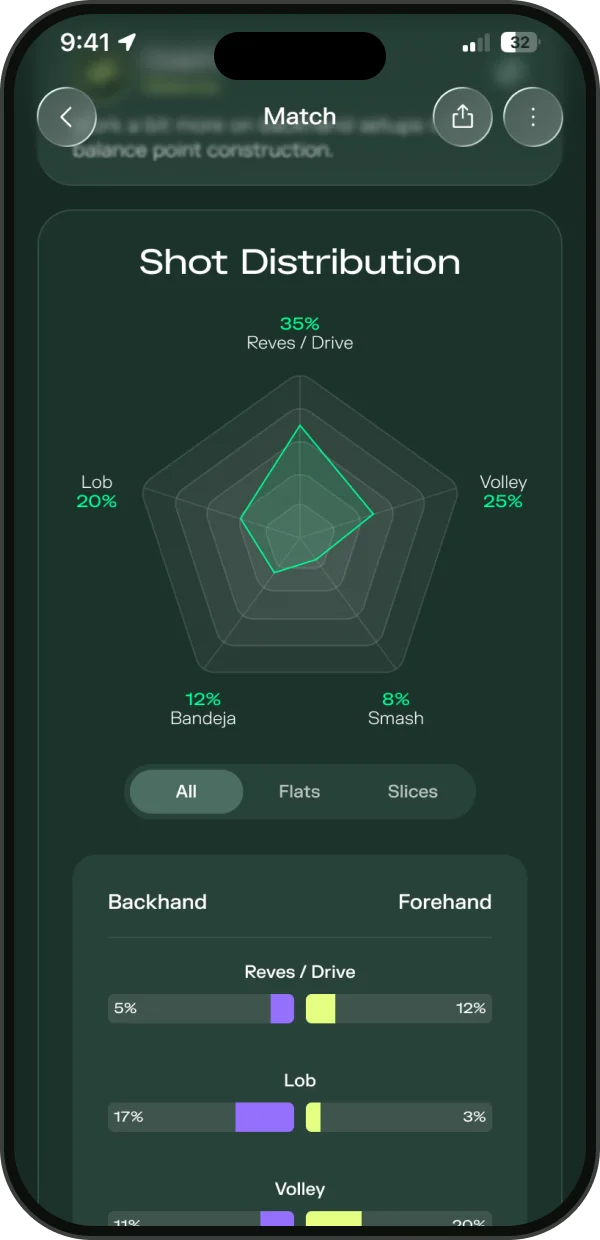
Shot distribution
How many of each shot type did you play? This is the foundation, and it almost always surprises people. A common finding is that players run around their backhand far more than they realise: a habit, not a strategy. Shot distribution also shows whether your training is working. If you have been practising your bandeja, you should see more bandejas in your matches over the following weeks.
Smash quality
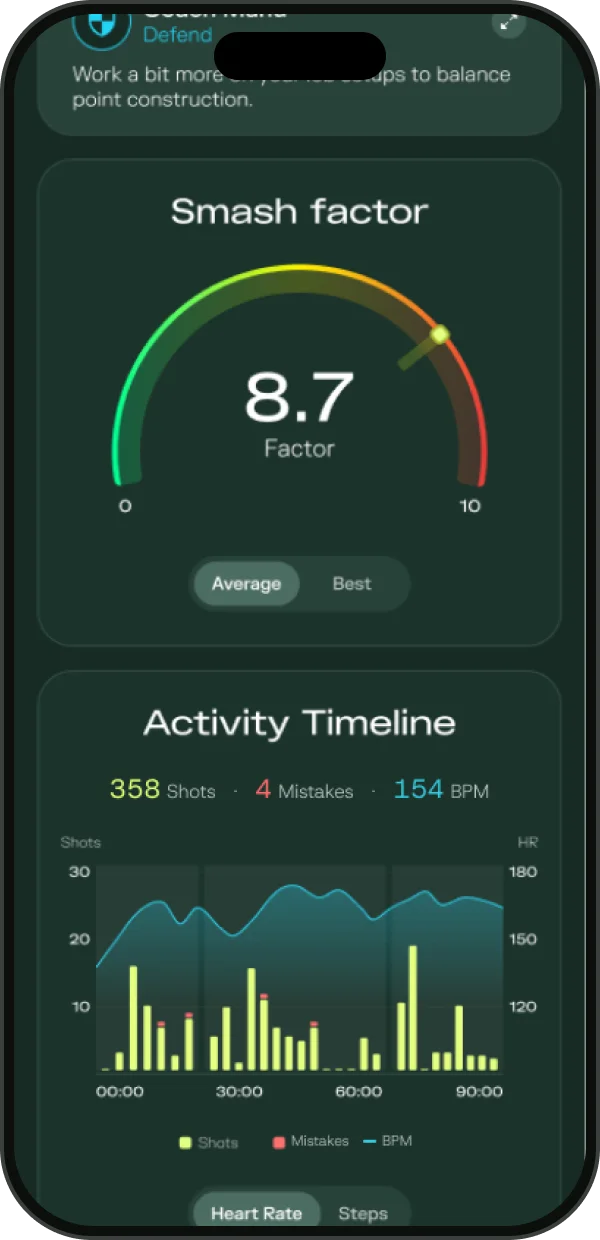
A good sensor scores the quality of your smash, not just the number of smashes. Padelplay calls this the Smash Factor: one number that reflects how well you hit it. Players whose smash feels powerful often score lower than they expect. The usual cause is technique, such as flat contact or too little body rotation, and that is exactly what a sensor on the racket picks up.
Mistakes
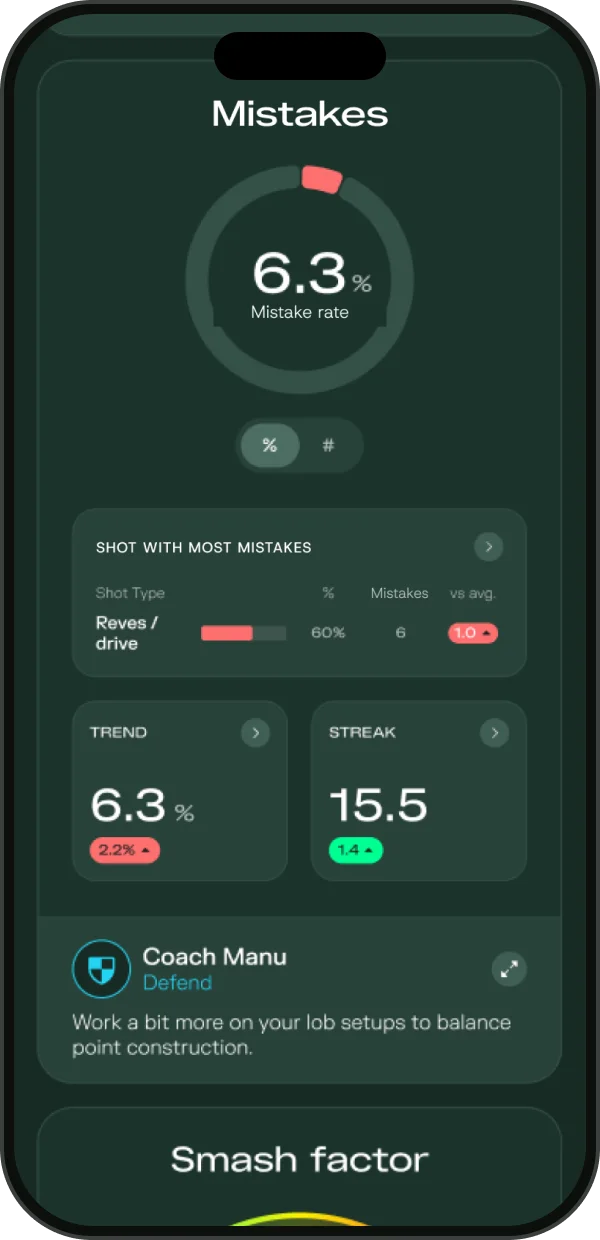
How many points did you lose on balls you should have controlled? Many points at club level end with a mistake rather than a winner, and most players underestimate how many they make. Seeing the number after each match, and seeing it fall over time, is one of the most motivating things a sensor can show you.
Session volume and trends
Total shots, session length and how both change over time. One session is interesting once; a trend across twenty sessions is where the real insight is.
What to be sceptical of
- Speed figures without context. Ask how they are measured before you trust them.
- Court position. Knowing where you stand on court needs cameras. A sensor on your wrist or racket cannot measure it reliably on its own.
What to check before you buy
- Shots recognisedAt least forehand, backhand, volley, smash, bandeja, lob and slice. Padelplay recognises them with 85% accuracy or higher, depending on the shot.
- Battery lifeA match lasts 60 to 90 minutes and you will forget to charge sometimes. Padelplay lasts up to 8 hours of play.
- Racket fitA racket-mounted sensor has to fit your handle. Padelplay fits about 85% of padel rackets.
- SetupA sensor you find annoying to set up is one you stop using. It should pair quickly and need nothing before each session.
- The appHistory, trends and a breakdown per shot, not only last session's totals. Check what is included without a subscription.
- WeatherOutdoor padel means rain and sweat. Make sure the sensor is waterproof, like Padelplay.
Who should buy a padel sensor
It makes sense if you
- play once or twice a week and want to know why you are not improving faster
- work with a coach and want objective data for your lessons
- have hit a plateau and need to know what to work on next
- play competitively and want to track your progress
It probably doesn't if you
- only play a few times a year: you won't build up enough sessions to see trends
- want a replacement for court time: a sensor measures your game, it doesn't replace practice
The bottom line
A padel sensor is worth it if you are serious about improving. It shows you what memory and feeling cannot, and it tells you whether your training is working. Between the two types, accuracy decides: a wrist sensor is convenient, a racket-mounted sensor measures what actually happens at the racket.
Padelplay is a racket-mounted sensor that works with the free Padelplay app on iOS and Android. It recognises forehands, backhands, volleys, smashes, bandejas, lobs and slices, scores your smash, counts your mistakes and gives personal advice through AI coach Manu after every session. See how Padelplay works.